
Osteopathy · How we work
Osteopathy
Assessing the body and deciding where to start.
You tell me what’s wrong and what you’d like to be able to do again. I’ll then assess how your body is doing and we’ll decide where to start.
If you have a specific complaint, we’ll start with that. If you’re looking for a general check-up without a specific problem, you can start with the body check-up.
What is osteopathy?
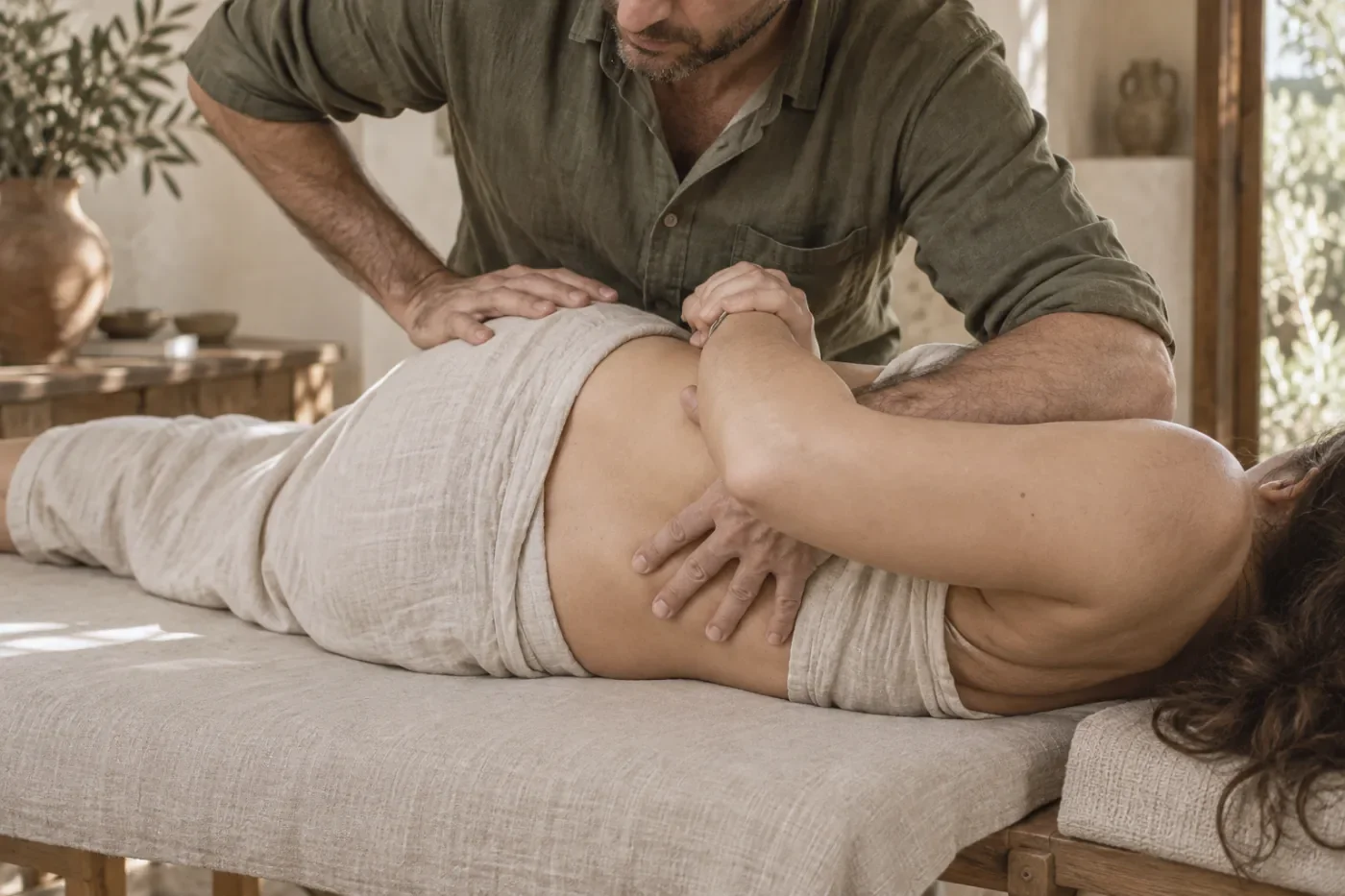
Osteopathy uses manual techniques. During your consultation, I’ll assess how you move and tailor the treatment to what we find.
First, let’s talk about what’s wrong with you
Tell me what has brought you here, how long you’ve been experiencing these symptoms and how they make you feel. We’ll also discuss what treatments you’ve tried, what helped you and how long the relief lasted.
Sometimes other things come to light which, at first glance, might not seem important to you, but which help me to better understand what is going on: changes in breathing, tension in the abdomen or discomfort that recurs with certain gestures or movements. All of this can provide useful information.
We’ll also discuss your goals. The first priority is usually to relieve pain, of course. But I’d also like to know what you’d like to be able to do again, what’s affecting your day-to-day life, or which problem has been recurring for too long.
We then move on to the initial assessment. I observe how you move, which areas are involved and how you’re feeling at that moment. I assess the structural, visceral, cranial or postural aspects, depending on what I find. Experience helps me recognise certain things, but palpation is essential. Every person arrives with a different story, and so does their body.
What I look for when I assess you
My work has a simple aim. I want to understand what’s bothering you, how it’s holding you back, and what we can work on to help you feel better.
- We’ll look at which movements you find difficult and where the tension is located. I’ll examine the area causing you discomfort and analyse what might be causing this tension.
- The aim is to restore balance to your body through a specific osteopathic treatment. I’ll explain what I’ve observed and where we’re going to start. I tailor the manual therapy to what I find and to how you feel during the session.
- I’ll advise you on the most effective measures for your specific situation to improve and maintain your health. We’ll agree on what to look out for over the next few days. If it would help, I’ll show you some simple exercises to do at home. That’s where postural re-education comes in.
Sometimes it’s just a cosmetic fix
Neck pain may well originate in the neck itself. And if you’ve injured yourself whilst lifting something heavy and have lost mobility in your lower back, we’ll start by assessing what’s going on there.
In such cases, structural work focuses on the joints, muscles and fascia. I also assess the spine, pelvis and surrounding areas to understand how they are moving and what tensions are present.
I don’t aim to make joints crack. I work with manual techniques that are usually gentle, adjusting the intensity according to what I find. If I do use a manipulation technique, it doesn’t have to be abrupt or applied directly where it hurts.
Through palpation, I assess how the tissue responds and adapt the treatment accordingly. If the problem requires work on a specific area, that is where we focus.
When you’ve been going round in circles for months
Some people come to see us after three or six months of suffering from the same problem. Others have been struggling for years. They have tried physiotherapy, manual treatments or other therapies. Sometimes they felt better for a while; other times, they barely noticed any change.
They often come in, tired of repeating the same story. That’s why we start by talking about what’s happening to them, the treatments they’ve had and how the problem has developed.
I then assess how your body moves, identify any areas of tension and determine which areas may be related. I also observe your breathing and examine your abdomen when this provides relevant information for the assessment.
Based on all this, I decide where to work: it may be in the area causing discomfort or in a related area. Examination and palpation help me to identify these connections and tailor the treatment to each individual.
You may have come here looking for structural, visceral or cranial osteopathy. That’s quite normal: these are the terms that usually come up on Google and help you find your way around. But in my practice, I don’t compartmentalise my work into three separate categories, nor do I follow a fixed sequence of techniques. I use them naturally, depending on what I discover and what each individual needs.
Most people don’t turn up for a consultation saying: “I think I need visceral osteopathy”. They come because their lower back hurts, because their shoulder has seized up whilst playing football, because something is bothering them when they dance, or because, after a fall, they can no longer sit or drive without feeling pain in their tailbone.
Sometimes a patient comes in who clenches their jaw so tightly that they’ve already tried several mouth guards and are sceptical that another one will make any difference. Or someone who’s been sleeping poorly for a long time and feels drained of energy.
And then there are those who don’t know where to start. They just know they don’t want things to carry on like this. So that’s where we’ll start.
How can I help you?
Osteopathy helps to relieve pain and improve mobility in certain conditions affecting the back, neck, muscles and joints. In my practice, I also treat people with abdominal or jaw discomfort, recurring tension or difficulty sleeping.
You don’t need to know which type of osteopathy you need. Just tell me what’s wrong, how long it’s been going on and what’s stopping you from doing things. We’ll start there.
Musculoskeletal system
- Back and spine: neck pain, cervical pain, upper back pain, lower back pain, stiffness and recurring discomfort.
- Muscles: muscle knots, spasms, strain, tightness and discomfort during recovery from muscle fibre tears and other muscle injuries that have already been assessed.
- Joints: pain, stiffness, restricted movement and discomfort following sprains or injuries.
- Radiating pain: sciatica, pain radiating to the buttock or leg, cervicobrachialgia and symptoms experienced by people with herniated or protruding discs.
- Recovery following surgery: tightness in scars and tissues, stiffness or restricted movement once recovery allows for manual therapy.
- Pregnancy: specific back, pelvic and muscular discomfort, with an assessment tailored to this stage.
Head, neck and jaw
- Headaches: particularly when accompanied by tension in the neck, nape of the neck or temples.
- Migraines: assessment of any cervical, jaw and muscular discomfort that may also be present.
- Temporomandibular joint (TMJ): pain when chewing, difficulty opening the mouth, clicking sounds, bruxism and jaw tension.
- Dizziness and tinnitus: assessment of co-occurring neck and jaw discomfort, whilst also investigating the cause of these symptoms.
Abdomen, digestion, pelvis and breathing
- Digestion and the abdomen: heartburn, indigestion, constipation, bloating, distension and discomfort experienced by people with a hiatal hernia.
- Diaphragm and ribs: tension beneath the ribs, stiffness in the torso, abdominal discomfort and restrictions you notice when breathing or moving.
- The pelvis and menstruation: period pain, cycle-related lower back discomfort and tension in the lower abdomen or pelvis.
- Ovaries and bladder: manual assessment of tension in the abdominal and pelvic tissues, taking into account existing symptoms and diagnoses.
- Kidneys and lower back: assessment of back discomfort and the tissues in the lower back and abdominal regions where it is relevant to evaluate them.
- The thyroid and anterior cervical region: assessment of discomfort and tension in the neck tissues when these form part of the reason for the consultation.
Visceral osteopathy forms part of my practice. I examine the abdomen, the diaphragm, the fascia and the anatomical relationships between these structures and the ribs, spine and pelvis. The assessment includes the areas surrounding the digestive organs, the kidneys, the bladder and the ovaries, where examination of these provides relevant information for the case. The aim is to address any discomfort, tension and physical restrictions I identify, using manual techniques tailored to each individual.
Sleep, rest and tiredness
- Insomnia and difficulty falling asleep.
- Frequent waking and poor-quality sleep.
- Feeling tired upon waking, persistent tension and difficulty resting.
I have also treated people who had been sleeping poorly for nearly two years. Some told me that, after five or six sessions, they had regained a more restful night’s sleep. That experience is part of my work and the care I take in monitoring each person’s progress.
In these cases, I assess the neck, jaw, breathing, diaphragm, musculature and any tension that becomes apparent during the examination. I incorporate gentle manual techniques and sacrocranial work depending on the assessment. We then review together how your sleep, waking patterns and sense of rest have changed.
Visceral work
The abdomen is connected to the diaphragm, the ribs and the lower back, and some visceral discomfort can be felt in other parts of the body. That is why, during the assessment, I observe how the abdomen moves as you breathe, what tension there is beneath the ribs, and whether digestive discomfort coincides with tension in the back. In visceral work, I assess the mobility and tension of the abdomen. I palpate the diaphragm and the tissues that connect different areas, and adapt my techniques to what I find. It is not a matter of repositioning organs or attributing every muscular discomfort to a specific organ.
Skull, neck and jaw
In some people, tension in the neck, the suboccipital region and the jaw are interrelated. I see this, for example, in cases of bruxism, difficulty opening the mouth or certain types of headache with a musculoskeletal component.
Cranial osteopathy is also part of my practice. I use very gentle manual techniques, paying close attention to the tone of the tissues, their mobility and how they respond during the session.
These techniques enable the treatment of tension in the cranio-cervical region using a gentle approach, whilst also taking into account the relationship between the muscular and nervous systems.
How I work on the treatment table
The treatment is 100 per cent manual. I do not use any therapeutic devices or machines.
Most of the techniques I use are gentle. I incorporate sacrocranial work in an integrated manner, as this allows me to continue assessing tissue tone and the body’s response as I proceed.
Some techniques may feel a little uncomfortable. I do not work on the principle that the more it hurts, the better it works.
I adjust the intensity myself, through palpation and continuous assessment of the area we are working on.
When regaining mobility isn’t enough
Sometimes the improvement achieved on the treatment table is enough. At other times, it is advisable to practise the movement that was still causing problems, to put weight on an area again, or to learn how to use the movement we have just regained.
This is where postural re-education comes in: a few exercises, practised and corrected during the consultation, to be continued at home.
If you’re not coming in for a specific ailment
You may not have a specific area in mind to pinpoint or treat. You simply feel that your body has been clocking up the kilometres for too long and that something has gone a bit out of kilter along the way.
The body check-up combines assessment and treatment in a single session. It is designed to check how you are doing when there is no specific ailment to serve as a starting point.
The body isn’t made up of separate parts
Sometimes we work on the area that prompted your visit. At other times, the assessment leads us to structures which, from your perspective, may seem to have nothing to do with that discomfort.
We can work away from the area that hurts, precisely in order to change what is happening there.
What type of osteopathy do I need?
You don’t have to choose it yourself. Just tell me what’s wrong and we’ll start from there.